I was motivated to research and write this article by my memories of the giant roadside Presto Whip cans that I marveled at as a boy.
A cream alternative
Bob Rich was a former dairy man from New York who was working as a consultant for the federal government monitoring milk production in the Great Lakes region. During World War II whipping cream sales were prohibited and dairy products were rationed.
A purchasing agent from Ford Hospital in Detroit explained to Rich that their entire supply of milk and cream was produced in Dearborn by Henry Ford's Carver Laboratory from soybeans. Rich was astonished as he had never heard of anyone producing milk from plants.
Rich visited the Carver institute and saw how Ford was isolating soy proteins for a number of different applications from car parts to food. The enterprising Rich was able to license the process for $1 a year from Ford.
1944 – Bob Rich forms Rich Products Corporation and develops one of the world's earliest and most popular commercial food products to use isolated soy protein as a significant ingredient--Rich's Whip Topping.
Delsoy
1945 – “Bob Smith (a former Ford researcher) and Herbert Marshall Taylor introduced Delsoy, a soymilk-based non-dairy whip topping. Made in Dearborn, it was sold mostly in Detroit to the restaurant trade. In the spring of 1945 it was introduced through retail stores in New York. “
Presto-Whip
1946 - Delsoy modified Chicago's Super Whip co's nitrous and valve design to create Presto Whip, the first soy based product in a pressurized can (with valve) of any food product. “Delsoy was America's earliest known commercial non-dairy whip topping. But it never became a very successful product. In part because it was not a frozen food, its distribution was limited to the Detroit area.”
Delsoy Products and Distributors and its successor operated out of a site at 2023 South Telegraph, at Harvard Street, Dearborn, Mi.
1963 – Delsoy is purchased by Harvey Whitehouse of Whitehouse Products Inc.
Sometime in the late 1960’s Whitehouse could not get permits to erect new storage tanks at the facility. Instead thery got permits to erect two large 30 foot Presto Whip signs with valves on their bottoms. These were placed conspicuously on Telegraph road and also helped to advertise this locally manufactured product.
Today
Sadly the original cans came down sometime during the ‘80’s, likely 1983 at the time Whitehouse Products, along with the Presto Whip trademark were sold to C.J. Christoff and sons of Lowell Michigan.
Every army marches on its stomach. The legions of auto workers that staffed the arsenal of democracy were no different. I recently re-experienced a Ford Motor company food favorite that has nearly lost its tradition. The Pepperoni Roll.
Lunch for the Rouge
When Henry Ford's massive Rouge plant opened in 1928, the east end of Dearborn was still the village of Fordson. At first, many workers at the plant traveled by streetcar to make their shifts at the factory.
As the prosperity and wages of the workers grew, these laborers were now able to afford their own Ford automobiles. Employees could now drive themselves to the Rouge in their new rides.
Support business grew rapidly in the shadow of old man Ford's place. Rooming houses, bars, and restaurants popped up like mushrooms along avenues like Miller, Michigan and Schaefer.
In 1929, Fordson consolidated with the village of Dearborn to become the City of Dearborn.
Schaefer Avenue, was a major thoroughfare that routed workers to the Rouge from their domiciles on the burgeoning Northwest side. The road was lined with many restaurants and bakeries where Ford employees could grab a bite before or after work.
In Detroit before unionization, a 15-minute lunch break was common. A lunch that could be purchased, transported and eaten quickly was of great value to thousands of workers. Sandwiches of meat and bread became the staple of many a paper bag or lunch bucket. In the U.K., compact meat pies were very popular and this recipe emigrated to the U.S. as well.
Music during lunch hour at Morley Knight Co. Detroit - 1942
Le Roll du' sausage
The first "Pepperoni Roll" or "Sausage Roll" is said to have been created in a little bakery in West Virginia. The baker saw coal miners on their lunch break with a sausage in one hand and a loaf of bread in the other. It was necessary to balance either on one knee while drinking a beverage. The baker solved this problem by baking sausage into the roll and offering it to the miners. The one handed Pepperoni Roll soon became very popular.
Just how this idea migrated to Dearborn Michigan has been lost to the ages. One might speculate that, as many workers from the south migrated to Michigan for jobs in the factories, so too did their recipes.
The Dearborn / Detroit pepperoni roll is very well known through the offerings of the original Roma Bakery at 6142 Schaefer Road, an east end landmark.
Roma Bakery's golden era started in the late '50's and lasted through the early '80s under the skillful hands of its original owners. Catering to thousands of locals and Ford commuters daily, Roma Bakers were most certainly the originators of the Pepperoni roll in Detroit.
The Roll today
In 21st Century Detroit, there are many purveyors of the venerable pepperoni or sausage roll a favorite of the assembly line worker. In Dearborn, there are 3 major contenders, each with its own spin on the original. As the best version has long been a point of contention between this author, his family and friends, I have decided to review all three to put any comparisons to rest through a comparative review.
Capri Bakery - 2012
The Roll: The dough is very good and just the right soft consistency. The Capri roll is subject to becoming "crusty" if left out too long, so they are best ordered early in the day fresh and hot. This roll is longer and thinner than the original Roma Bakery article however. Its extruded length may be a strategy to minimize the pepperoni filling.
The Pepperoni: Excellent spicy pepperoni that lives up to the legend. Sliced properly that is in keeping with Roma's of Dearborn. A little thin in serving size as compared to the other rolls reviewed. The Construction:
The added length on this roll means the dough is rolled fewer times. Fewer revolutions mean fewer pepperoni slices need be rolled in. It does not have the ideal girth and pepperoni serving size of the Dearborn Italian Bakery roll, for comparison.
Extras: None. The basic roll is available with sauce and cheese if you prefer.
Cost: $1.45 - Wow ! Extremely affordable.
Rating: B + Capri Bakery
4832 Greenfield Rd Dearborn, MI 48126
(313) 584-4449
Dearborn Italian Bakery - 2012
The Roll: Is nicely shaped and the dough consistency is very good. This roll has the exact shape and girth of the original Roma's Dearborn roll. Not too chewy or dry. Obviously baked side by side, as you can see the separation mark. Not crusty or hard at all.
The Pepperoni: Biting in to the roll, the "mouth feel" seems correct. However, suddenly you realize this is not necessarily the best quality Pepperoni. The fat component was very high to the degree that I am still not sure if there was a layer of butter in there or not ! It's also a pretty dull pepperoni, not spicy at all.
The Construction: This is my preferred distribution of pepperoni. Sliced, applied and then spiral rolled into the unbaked loaf. Dearborn offers a generous helping of pepperoni in their rolls.
Extras: The basic roll is available with sauce and cheese if you prefer.
Cost: $2.50 However, to their credit, the rolls are 3 for $5 on Fridays. Rating: B - Had they better Pepperoni they would have scored higher. They use the same Pepperoni on their pizza that I always mark down for the use of sugar in their red sauce.
Editorial:
Today's Roma Bakery physically bears little resemblance to the old shop patronized by thousands of Ford workers and school kids alike. A Lebanese couple purchased the building and name years ago. They have since expanded the premises, menu and building.
The original Roma roll was made of soft dough with sliced pepperoni rolled in and baked.
Today the Roma product is nothing like the original. The current owners recently, quite shamelessly connected themselves to the original recipe and the late Roma proprietors in this article: http://www.semichiganstartup.com/features/dearbornsromabakery
"About five years ago the wife of the original owner who has since passed away, visited the bakery and started crying as she hugged the Nemers, and thanked them for keeping the name."
They kept the NAME not the product. Proximity to the aging original owners does not qualify you for an endorsement.
"The pepperoni rolls at Roma Bakery, its biggest seller, have been locally famous for longer than half a century. A line on the business cards reads: “The Home of The Pepperoni Rolls.”
Do NOT build your business on a product, process and company that no longer exists. You do NOT have 50 years in business. This not a half-century old recipe.
“No one makes the pepperoni roll like we do,”Amal said.
That would be an accurate statement. It certainly is unique. Do not confuse the unique with the original.
The Review:
The Roll: Poorly shaped and oversized, the dough consistency is very "chewy". It appears to be a Calzone or even a distorted Cuban sandwich or Panini. It may as well be a loaf of flatbread.
The Pepperoni:Halal "pepperoni" is used. Halal is the Arabic word for "Permitted". Meaning food that is permitted under Islamic guidelines as found in the Qu'ran. While this is fine and a requirement of and for the Islamic community, these are not the old Italian processes for Pepperoni. It is just not the real article. The spices used in the Halal Pepperoni are very tame. NONE of the original pepperoni zing and rather "chewy".
Construction: The Pepperoni is NOT rolled in to the dough. They obviously haven't got this part figured out. It's like an oddly sliced pepperoni sandwich with two halves of dough, cheese and some meat sauce.
Extras: Sauce! Are you kidding ? No original Pepperoni roll would ever have sauce. You want sauce ? ... buy a Pizza ! In retrospect, it's possible that what I was served was their "Pizza Roll". So now both the service and the Pepperoni were substandard.
Cost: $ 2.50 ! I can remember paying $.50 for a roll back in the '70's. Sure, I understand inflation, but this price for a substandard product is outrageous. Rating: F - No ethnic group owns the pepperoni roll. It's just coincidence that in Michigan, Italian bakeries picked up on this American product for the American worker. The current owners offer a kind of loaf with meat that does not follow this tradition. Not that they are required to.
The "New" Roma roll was wholly unsatisfying and frankly just plain bad.
It bears no resemblance to the Michigan original.
Roma Bakery 6412 Schaefer Rd Dearborn, MI48126(313) 581-5000
Caviet Emptor In 2012, Ford motor is doing well although the number of employees at the Rouge has greatly diminished. The old lunch pails have given way to plastic min-coolers. And, in at least one bakery in Dearborn, workers can still find a one-handed Pepperoni roll worthy of the original ROMA BAKERY.
I made it to the Henry Ford this past weekend to view the new Driving America exhibit. This exhibit is long overdue as it has been decades since the Museum made any significant updates to its automotive vehicle displays. I was pleased to see that the exhibit now represents more recent history with an eye towards the future. The timeline display of vehicles is much more complete and, finally, up to date.
Racing and trucking are still categorically represented but in a less cluttered fashion. Related artifacts are now nicely incorporated into slick exhibit cases that help tell the story of transportation and the automobile's evolution.
I understand that one reason the former display had become stagnant was due to the difficulty in exchanging vehicles in and out. The Henry Ford appears to have solved that issue as it plans to further enhance Driving America with other cars that are normally stored off-site. Movement and storage of these treasures is certainly a tricky proposition at best.
I did notice for the first time that some, if not all of these vehicles were on axle stands. Tires are hovering a millimeter or so off the ground. This makes sense as it is probably pretty hard to find a set of tires for a 1931 Bugatti or 1896 Duryea !
It's nice to see some of the old favorites as well as some seldom seen cars from the collection.
Click on photos for more details.
Texaco Service Station
I also stopped by the Texaco Service station c.1946. The station has a service bay with a plastic mock up car that kids can "service". I watched two ten year olds change a tire, unsupervised! They were having a blast and looking for the oil ...
Lamy's Diner
It's great that the museum has made Lamy's diner functional. Originally a veteran's post-war start-up, it sat at various locations in Massachusetts until it was acquired by the museum in the '80s. Visitors can now stop in for refreshments and soak up some of the vibe from the mid-century road food era.
Interactive Displays
Being a techno-geek as well as a gear head I spent as much time with the interactive elements of the exhibit as with anything else. Here is that experience (in great detail) that I recommend you try for yourself.
Have you ever wanted to see, up close, the coils on Henry Ford's 999 or closely inspect the speedometer on the 1931 Bugatti Type A Royale? Well, now you can!
The Henry Ford has made a significant investment in technology for this exhibit with eighteen 42 inch interactive touch screen kiosks sprinkled amongst the displays. The museum has organized hundreds of high-resolution vehicle photographs and digitized many related artifacts all available to each kiosk visitor. Navigation is a breeze now that iPhones and iPads have made touch sensitive gestures familiar to millions. Driving America's kiosks are like using a 42 inch iPad; they serve as windows into the collections treasures. It's fun to free associate, zooming in and out of Hi-resolution images and playing back videos by personalities such as Bill Gates and Bill Ford.
So, if you would like to read that part number off the carburetor on the 1949 Volkswagen, now you can!
This digital collection content is never limited to the vehicle stationed behind each kiosk. The entire digital collection is accessible at every kiosk as well as on the Henry Ford Collections website.
My Collections Card
Perhaps the coolest feature of the interactive kiosks is their ability to read your "My Collections Card".
The My Collections Card or "MCC", as we will call it, is your passport to taking some of the digital collection home with you for further perusal. The credit card sized MCC uses the latest RFID technology to great effect.
Creating a "collection set" from your visit.
This process requires two things; 1) a Henry Ford Collections Website account and 2) a MCC card.
1) If you have been to the Henry Ford digital collections website and have already created an account, you are halfway there. In fact, I would recommend this prior to physically visiting unless you are comfortable enrolling in front of others touring the exhibit.
2) MCCs are available from any Driving America docent and are good for one day only.
When you visit your first kiosk, place the card on the black rectangle in the lower right hand corner.
The initial presence of your card begins the login process.
If you already have a Henry Ford collections website account, just enter your account (e-mail address) and password. Otherwise, you must create an account in order to proceed.
Once a valid account and password has been submitted, the account is "linked" to your MCC.
- No personal information is stored on this card.
- No collection information is stored on this card.
The MCC merely identifies you at each kiosk when you lay the card on the little black rectangle.
These cards have zero intrinsic or functional value outside of the museum.
Now you may browse through the collection archive at each kiosk. Selecting "add to my collection" adds any photo, video, or other digital artifact to your very own "collection". Take the card with you to the next kiosk.
I saved a bunch of my favorite artifact images to my MCC and dropped the card off at the desk upon exiting the museum. The Henry Ford purges these cards daily thus breaking the connection between the user and the card.
At home I received an e-mail containing a web link to my new "collection set" labeled with the date of my visit. Upon opening the set I found all the items that I had added to My Collections Card ! Nice ...
On the Henry Ford collections website you can create additional collections and even build a "virtual exhibit" ... lots of fun! Here's my Virtual Exhibit created from items I encountered that day.
Next Time
These interactive components are great and a wonderful way to engage younger visitors. There are no fewer than 12 additional interactive games and experiences at these kiosks that I did not have time to check out.
I'll be going back to do just that and to inspect the physical artifact cases at length. Also I'll be sure to to have a seat at the diner for a beverage. I wonder if I can get a Yoo-Hoo? - Leo Early
Packard Motors Many Detroiters are familiar with massive 35 acre Packard plant on East Grand Boulevard. The 33,000,000 ft. facility opened in 1903 and was home to Packard Motors manufacturing through 1958. In the 1920's Packard was the number one manufacturer of luxury automobiles in the United States with gross income exceeding $29 million in 1928. What has been forgotten has been Packard's substantial contribution to the Allies' efforts in World War II. Packard engines proved critical to the air war in the European theater.
Rolls Royce Founded in 1906 the partnership of Rolls Royce began manufacturing automobiles in Derby, Derbyshire in 1907. By 1918 approximately half the aircraft engines used by the Allies in World War I had been made by Rolls-Royce. By the late 1920s, aero engines would make up most of Rolls-Royce's business. The company's tradition of manufacturing aircraft engines continues to the present day with The Rolls Royce Trent 800 engine powering Boeing's latest model, the 777.
The Merlin Company founder Henry Royce's most powerful aircraft engine design began manufacture two years after his death In 1935. The 12 Cylinder supercharged Merlin was capable of propelling aircraft at speeds in excess of 400 MPH. Rolls Royce followed the convention of naming their propeller driven aero engines after birds of prey. The Merlin is a European falcon. The new engine would first see service in the Supermarine Spitfires and Hawker Hurricanes flown by the RAF. After France's surrender in June of 1940, British convoys and shipping centers were under increased attack from the air. By August this method of warfare had spread to RAF airfields and aircraft factories.
Rolls Royce Merlin Line - 1942
As the Battle of Britain progressed, the Rolls Royce Merlin became vital to the British war effort. So much so that it became critical to find a secondary manufacturing line outside of the embattled United Kingdom. Rolls Royce engineers toured several U.S. manufacturers to assess their capabilities for adapting the Merlin to mass production processes.
In July of 1940 Henry Ford rescinded his son Edsel's initial offer to produce 6000 Merlin engines for the U.K.. An isolationist, Henry was insisting that he produce these engines his way and that they be used "only for Defense."
The Packard V1650 Merlin After the Ford deal fell apart, Roll Royce awarded a 130 Million Dollar (2.1 Billion in in 2011 dollars) U.S. contract to Packard Motors in September 1940. Packard licensed the Merlin engine from Rolls-Royce as the V-1650. A liquid cooled, 27 Liter, 12 Cylinder, 1600 Horse Power, super-charged behemoth. Production at the East Grand Boulevard Plant began in August of 1941.
Packard - Rolls Royce Assembly - Courtesy W.S.U.
This undated Wayne State Archive photo notes Maj. James H. Doolittle inspecting what appears to be a landmark Packard Merlin engine. Considering Dolittle's rank at the time, this was likely the first Merlin (Sept. 1941). In 1940 Doolittle was still a Major and assistant district supervisor of the Central Air Corps Procurement District in Indianapolis, Indiana and Detroit where he worked with large auto manufacturers on the conversion of their plants for production of planes. He was recalled to active duty in January of 1942 and promoted to Lieutenant Colonel.
Britain's newly appointed Ambassador traveled to the U.S. in January 1941. Here he is at Packard inspecting a Merlin on a test stand. (Photo Courtesy WSU)
LORD HALIFAX LEAVES FOR THE USA
Packard would ultimately produce just over 50,000 Merlin Engines.
50,000 Packard Merlin
The P-51 Mustang In the summer of 1940 the British government also went shopping in the U.S. for a new generation fighter air-frame. After having been awarded the contract, North American Aviation delivered their first P-51 Mustang prototype to England in September of 1941. This initial version of the Mustang, the P-51A, featured an Allison V-1710 power-plant. Unfortunately, its single stage supercharger proved unworthy at high altitudes and was difficult to maintain.
By late-1943 the Allison engines were replaced with the Spitfire proven Packard V-1650 Merlin engines and their new two-stage superchargers. The two-stage supercharger afforded the P51-B Mustangs the high altitude performance necessary to escort allied bombers deep into the heart of Germany. P51-B Mustangs could reach 437 MPH at 30,000 feet and run up to 7 hours with their additional wing mount "drop" tanks. GI's nicknamed the Mustang (ironically for Packard) "The Cadillac of the Skies" and their 42,000 ft. service ceiling dramatically increased their survival rate. This survival also insured the success of our bombers' missions and thus tipped the balance of European theater air superiority. By 1944 Air supremacy was won over the whole of Germany thanks in large part to Packard Motors of Detroit, Michigan.
In 2011 Motor City music cognoscenti began murmuring about the authenticity of a Motown piano being restored by ex-Beatle Paul McCartney and Steinway New York. Here is the story of how that project came to be.
Hitchhike to Hitsville
When Paul McCartney played Detroit's Comerica Park on Sunday July 24, 2011, he and his band played a cover version of Marvin Gaye's 1962 hit "Hitchhike" as a tribute to the legendary Motown record label.
During the song's introduction, McCartney alluded to his entourage's visit to The Motown Museum on West Grand Boulevard. The ex-Beatle shouted "Holy Grail!" as he briefly related their tour experience to concertgoers. Paul and his crew had stopped in for a private tour. The museum is normally closed on Sundays.
McCartney arriving at Motown Museum
CEO Audley Smith, Paul McCartney and Curator Lina Stephens
Although McCartney and his crew thoroughly enjoyed their visit, the legendary musician was left flat by one particular museum artifact. A distressed Steinway 9 Foot grand piano on display in Hitsville's studio was sadly not in playable condition.
Apparently, this struck a sour chord with McCartney as he made an offer on the spot that the non-profit museum could not refuse. On October 26, Sir Paul and the Motown Museum announced plans to partner with the Steinway Corporation in the restoration of the aged piano.
According to the October 29, 2011 Detroit Free Press, "The 134-year-old piano, used on innumerable recordings in the 1960's, had long fallen into disrepair..." McCartney said via a museum statement this afternoon. "I said to myself; "Wow! This is the Holy Grail!"
Sir Paul thereafter provided financing for Steinway Corporation in New York to restore the innards of this 9-Foot Steinway Model D concert grand.
Plans were then being made to book performers to play the piano at a concert benefiting the museum in March of 2012.
Holy Grail or Staged Prop?
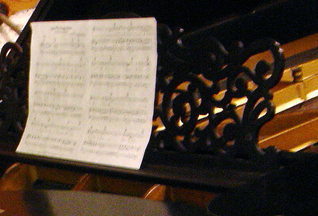
No sooner had news of McCartney's magnanimous contribution hit the streets than rumblings began in Detroit's Motown community. For starters, since the museum opened in 1985, tourists and insiders alike had been told by staff that none of the studio A instruments were original.
Motown Records staff did not recall an "art case" 9-Foot Steinway Model D being in studio A during the record company’s heyday.
Former Motown studio manager/producer Ralph Terrana supported photographic evidence specific to the music desk (stand) on the McCartney restoration piano: "I ..remember the Studio A Steinway NOT having the art case scroll work on the music desk”
Restoration piano - "Art Case" Music Desk/Stand
Ralph Terrana’s career with Motown spanned the years 1969 to 1975.
c.1965 - This black and white photograph corroborates Ralph Terrana's recollection. An alternate Steinway option to the fancy Art Case Scroll work, A grand piano with a solid music desk/stand in studio A at Hitsville.
Eddie Holland -left. - Lamont Dozier - right at Studio A Steinway
1965 - James Jamerson Jr.
Bassist James Jamerson Jr. recalled being a small boy next to a small grand piano, "I was nine years old when I became interested in what my father was doing.” James' father and legendary bassist James Jamerson would sometimes bring his children to sessions on the weekends. "My brother and I would line up between the keyboard end of that small piano and my father...we would just try not to get in the way." It was cramped at that end of the "snake pit" with three guitar players, a bassist, two kids and a grand piano. A nine-foot concert grand piano would not have been a logical choice for a tiny working studio. James says of the museum's current instrument in question, "that piano is longer; the piano I remember wasn't near that long."
1965 - Ed Wolfrum
Motown and Golden World engineer Ed Wolfrum remembered; "there were actually two Steinway grands .. because the one from Golden World was not as nice as studio A's."
In fact, Ed along with session pianist Johnny Griffith, purchased the Golden World Steinway at Grinnell's in Detroit as tasked by original studio owner Ed Wingate. Golden World staff and assets were absorbed by Motown in late 1966.
J.J. Barnes backing Edwin Starr on the new Golden World Steinway -5-20-66 DFP
Grinnell Brothers Pianos, Detroit. Courtesy Wayne State University
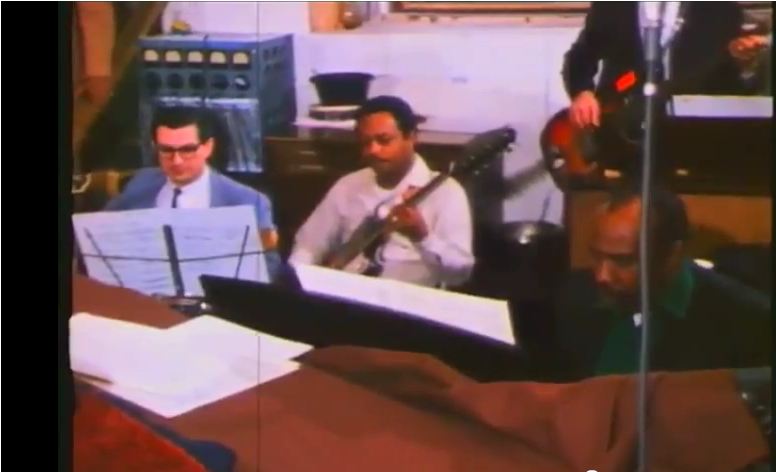
1967 – Video Evidence
A Temptations recording session was staged for the cameras in Hitsville Studio A. In this clip at 1:45 pianist Earl Van Dyke can be seen playing a Grand piano with a solid music stand. The piano also has a heavy cover upon which winter coats were often added to isolate the microphone.
Earl Van Dyke at Steinway with solid music stand.
1972 – The Move west
All usable instruments and recording equipment were collected and shipped to Los Angeles when Motown ceased operations in Detroit.
"In 1972 every available technician documented and packed up all the studio gear and loaded it up into trucks. I know the Golden World (Motown Studio B) piano went because I watched it being hauled up a ramp into a semi-trailer." Ed Wolfrum recalls.
Short of access to company inventory or serial number records, this is what we may now deduce about the Motown Detroit piano inventory:
Steinway # 1 "The Hitmaker"
Berry Gordy, himself a piano player and composer wrote or performed some of the early Motown hits on the original studio piano at Hitsville. Certainly, Motown’s CEO would not leave this precious instrument behind in Michigan, mothballed in a building with an uncertain future. It is also unlikely he would allow it to be installed at Mowest, his new L.A. recording facility. Insider statements and processes of elimination suggest that Berry has enjoyed the original Detroit Studio A - Steinway Model B - 7- foot piano in his Los Angeles living room since 1972. The retiree has recently purchased a home in Palm Desert California. A statement verifying the fate of this instrument is welcome from Mr. Gordy.
(In this photo courtesy of Vanity Fair magazine c.2009, Mr. Gordy is seated at what appears to be a Seven Foot Grand; I have not verified this is a Gordy residence at this writing)
Steinway # 2 - "The Golden World Piano"
Mowest studios, Gordy's Hollywood facility, may have received one of the Steinway Detroit pianos. Logic dictates that this is the original Golden World instrument as purchased by Ed Wingate and Ed Wolfrum. Berry Gordy would have discerned between the two and selected #1 “The Hitmaker” for his home.
Allen Sides former owner of Oceanway Studios appears to have acquired and installed the #2 piano at the Hollywood (Studio A) location. In 2012 the company counted "the original Motown piano" on their studio equipment list. It is reported to be a 9 foot Model D however. Oceanway has hosted a number of artists including Bonnie Raitt, the Rolling Stones, John Mayer and ..... Paul McCartney. Verification on Model and lineage is pending. In 2015 Oceanway became (in part) East/West studios. The 9 foot Steinway appears to have been part of the ownership transfer.
Motown Steinway Grand at Oceanway StudioA - 2012
East-West Studio 3 -- 2022
In 2012 Oceanway Hollywood owned two Steinways. The Model of the instrument in this clip is unverified as the Motown piano.
1985 – Staging the Museum
When Hitsville re-opened as a museum, Funk Brother and guitarist Dennis Coffey was called in to consult. "When the Motown Museum was just beginning, they had a deal with the Henry Ford Museum to do a two year display of Motown artifacts. The previous curator of the Motown Museum and the curator of the Henry Ford Museum and I went to Hitsville and opened the door to Studio A that had been closed since 1973. The studio was empty. I told them no one would want to tour Studio A like that. I suggested they stage the studio with instruments. They agreed and I pointed out who sat where and what instrument each Funk Brother played. They went out and purchased or found those instruments. I have no idea where they got them from." By the time the museum was opened a 9 foot Steinway was located amongst the museums holdings and staged in Studio A at Hitsville.
2001 – Standing in the Shadows
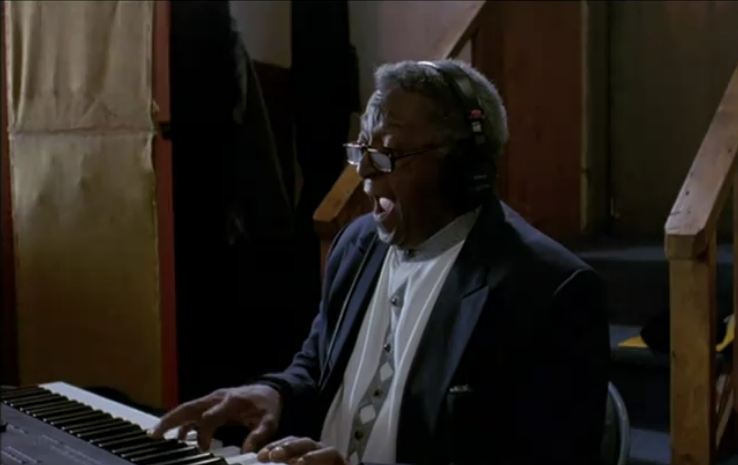
Ed Wolfrum was also involved in the motion picture “Standing in the Shadows of Motown” The surviving Funk Brothers assembled once again to record in Studio A. Ed was hired to help re-create the studio experience for the film.
The 9-foot "prop" grand was in such a poor state that keyboardist and original Funk Brother Joe Hunter had to play a substitute digital piano. Wolfrum watched the session from the original control room with museum founder Esther Gordy Edwards who whispered to the Motown veteran, "It's a shame we don't have the original piano for Joe to play." Joe Hunter passed away in 2007. Esther Gordy Edwards left us in 2011.
Joe Hunter - Studio A - 2001
Steinway #3 "Golden World Rehearsal Piano" 8-31-12
Today the Motown museum announced the debut of a restored piano at the Motown Gala in New York September 18. Although I won't be attending the $10,000 a plate fund raiser I am pleased to see the organization has admitted the actual lineage of this particular piano. A second Golden World piano, an 1877 nine foot Steinway that apparently, even in 1972 was not worth shipping to California. The instrument was used for songwriting and the occasional rehearsal only at the Davison Avenue Golden World /Motown Studio B facility. Golden World engineer Ed Wolfrum stated:
"That old piece of firewood was a disaster at Golden World and I would bet the Steinway crew had even more work on their hands than expected. It could only have gone downhill from the bad condition it was in then over 40 years ago." On August 31,2012 The Detroit Free Press' Brian McCollum interviewed Robin Terry, chairman of the museum's trustees board.
"Terry also clarified the history of the piano, which was described in a news release last fall as the instrument used on recordings by acts such as Stevie Wonder and Marvin Gaye. That account was disputed by Detroit Music Historian Leo Early."
"Terry said Thursday the museum has since learned that the piano was in fact used for songwriting and rehearsals at Detroit’s Golden World studio, which Motown purchased in 1967, and was not used on recording sessions". "Publicity about the restoration brought forth a lot of great stories from our alumni and others – piano technicians, people who had worked on that piano — and that helped us weave the story together” she said. “Our interest is having accurate, factual historical information, and this really caused that to happen.” DFP 8-31-12
Conclusion
There were in fact THREE original Steinway grands used by Motown/Golden World between 1959 and 1972.
As part of Motown's project Harmony fundraiser McCartney and Berry Gordy unveiled the restored Golden World-Motown Steinway at Steinway Hall in New York to a handful of privileged donors.
I am very excited about the return of the piano to Detroit.
Its installation will create additional programs for kids as well as for Detroiters and Motown fans in general. Thanks Paul ! Leo Early September 2012
4-1-13 The restored Steinway #3 is returned to Hitsville